
The best training room for workshops in Lekki is The Palmington on VFC Close, Ikate — a dedicated 12-seat education workshop venue in Lagos with seamless power backup, non-shared fibre internet, professional AV, and flexible half-day or full-day bookings.
What Are the Non-Negotiable Infrastructure Requirements for a Corporate Workshop Venue in Lagos?
Most Lagos venues marketed as “training rooms” are repurposed event halls with folding chairs and a borrowed projector. For corporate trainers and L&D managers, that creates a reliability problem that compounds quickly once participants are seated and the session clock is running.
Infrastructure requirements fall into four hard categories: power continuity, internet reliability, display technology, and acoustic control. Each one is non-negotiable, and Lagos conditions make each one a genuine risk to get wrong.
Power continuity is the first filter. NEPA outages in Lekki happen without warning, and a training session interrupted by a generator changeover — with its associated delay and noise — is a productivity loss that cannot be recovered. A professional education workshop venue in Lagos must have a seamless power backup system, ideally with an automatic transfer switch, so participants never register the transition.
Internet reliability is the second filter, and arguably the most frequently underestimated. Shared hotel WiFi, building-wide broadband, and mobile hotspots all introduce latency and drop-out risks that derail live demonstrations, cloud-based training platforms, and video conferencing with remote facilitators. The Palmington addresses this directly with a dedicated, non-shared fiber internet infrastructure — the connection is not competed for by other rooms, events, or co-working tenants operating simultaneously.
Display technology matters at the content delivery level. A presentation screen sized appropriately for a 12-person room ensures every participant reads slide text clearly without straining. Venues that substitute a television mounted in a corner, or a portable screen propped against a wall, signal that the space was not designed for training delivery.
Acoustic control is the often-invisible requirement. A room adjacent to a catering kitchen, a corridor with foot traffic, or a shared wall with another event space creates consistent distraction. Corporate training depends on sustained participant concentration; ambient noise is a structural problem, not a temporary inconvenience.
What Seating Layout Works Best for Interactive Corporate Training?
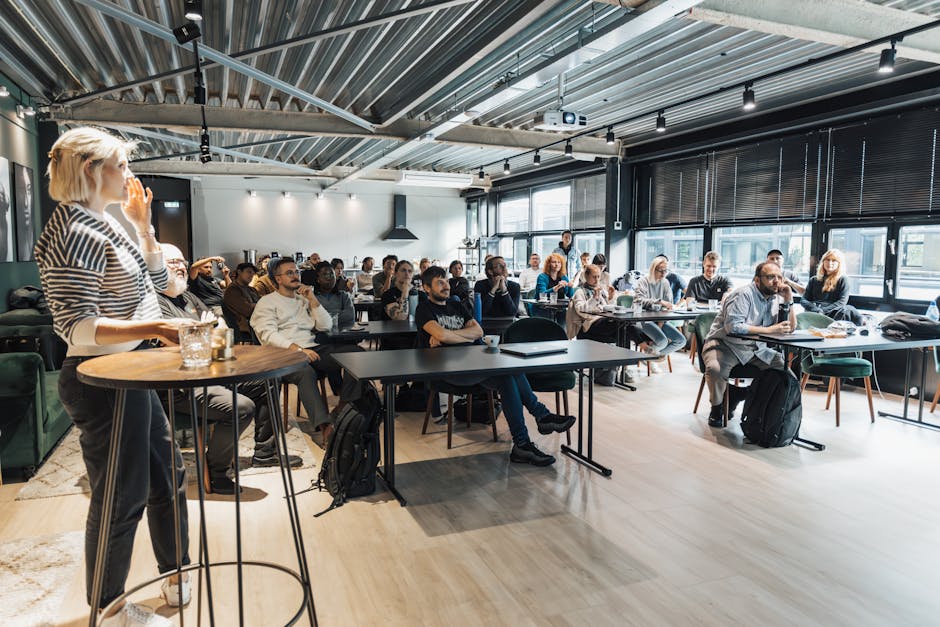
Seating layout is a training design decision, not a décor choice. The wrong layout for the session format actively suppresses participation, reduces eye contact between facilitator and participants, and makes breakout discussions physically awkward.
There are three primary configurations used in professional corporate training, and the correct choice depends entirely on the session methodology:
- Classroom Style: Rows of tables facing the facilitator and screen. Optimal for instruction-heavy, content-dense sessions where participant-to-facilitator flow dominates. Best for compliance training, product knowledge sessions, and technical skill transfers where note-taking is heavy.
- Boardroom / Conference Style: All participants seated around a central table facing inward. Optimal for peer-learning formats, case study discussions, and workshops where cross-participant dialogue is as important as facilitator input. Promotes accountability and visible engagement.
- U-Shape / Horseshoe Style: Tables arranged in an open U, with the facilitator presenting at the open end. The most versatile layout for mixed-method training: it supports both direct instruction and group discussion without requiring participants to crane their necks or reposition chairs mid-session.
The Palmington‘s training room was designed with modular worktables specifically to support all three configurations within the same booking. A trainer running a morning theory session can restructure the room into a U-shape before the afternoon practical discussion without requiring venue staff intervention. That flexibility is a genuine infrastructure feature, not a marketing claim — it is built into how the tables are sized and weighted.
For groups up to 12 persons, the U-shape consistently produces the highest interaction rates in corporate training research. Participants maintain sightlines to both the facilitator and to each other, which reinforces the psychological safety required for open skill-building exercises.

What AV Equipment Do Professional Training Rooms Need?
The AV stack inside a training room defines the ceiling of what a facilitator can deliver. Under-equipped rooms force trainers to simplify their methodology to fit the technology available, rather than letting the technology serve the training design.
A professional education workshop venue in Lagos should carry, at minimum:
- A large-format presentation screen scaled to the room’s seating depth — not a television repurposed as a display
- Reliable HDMI and wireless screen-sharing connectivity compatible with both Windows and macOS devices
- Stable, dedicated internet capable of supporting simultaneous video streaming, cloud application access, and video conferencing without throttling
- Sufficient power outlets distributed across participant worktables, so laptop-dependent exercises do not create cable-management hazards
- Consistent, evenly distributed air conditioning that maintains a stable temperature for groups of up to 12 persons across a full-day session — because a room that is cold at 9:00 AM and warm by 2:00 PM has an HVAC design problem, not a usage problem
Beyond the hardware checklist, the AV setup must be operationally simple. Corporate trainers are not AV technicians. A setup that requires a 20-minute troubleshooting session before the first slide loads costs the session irreplaceable opening momentum. Venues that provide clean, pre-tested, ready-to-connect setups reduce facilitator cognitive load and allow sessions to open professionally and on time.
What Is the Corporate Trainer’s Venue Requirements Checklist?
Before confirming any education workshop venue in Lagos, a corporate trainer or L&D coordinator should audit the following requirements. A venue that cannot confirm all items presents a delivery risk worth factoring into the booking decision.
- Power backup: Confirm seamless generator or inverter backup with automatic transfer — no manual switch delay during sessions
- Dedicated internet: Verify that the connection is not shared with other tenants, rooms, or simultaneous events in the building
- Seating flexibility: Confirm that the room supports classroom, boardroom, and U-shape configurations within the same booking slot
- Presentation display: Confirm screen size is appropriate for the room’s seating depth and that HDMI connectivity is available and pre-tested
- Air conditioning: Confirm that the AC system maintains consistent temperature across a full session duration, not just during the first hour
- Acoustic separation: Confirm that the room shares no active walls with catering areas, corridors, or concurrent events
- Catering access: Confirm whether tea, coffee, and refreshment service can be integrated into breaks without disrupting the room setup
- Parking access: Confirm on-site or proximate parking for the expected number of attendees — particularly relevant for Lekki Phase 1 locations during peak hours
- Booking window: Confirm whether half-day slots are available if your session does not require a full-day commitment
- Capacity confirmation: Verify the room’s certified capacity matches your group size — not a maximum figure achieved by removing all tables and stacking chairs
How Much Does It Cost to Rent a Workshop Venue in Lekki for a Full Day?
Pricing structures for training room hire in Lekki vary based on four variables: room capacity, session duration, included tech infrastructure, and whether catering is bundled or billed separately. Understanding what each pricing tier actually delivers prevents the common situation where a low headline rate conceals expensive add-ons for WiFi access, AV setup, or generator fuel surcharges.
The table below outlines how half-day and full-day training room configurations compare across the key delivery dimensions a corporate trainer must account for before confirming a booking.
| Configuration | Duration | Capacity | Tech Inclusions | Catering Options | Backup Power |
|---|---|---|---|---|---|
| Half-Day (Morning) | 9:00 AM – 12:00 PM | Up to 12 persons | Presentation screen, dedicated fiber internet, full AC, power outlets at workstations | Mid-session refreshment break integration available; self-contained tea/coffee service recommended | Seamless generator backup included; no session interruption |
| Half-Day (Afternoon) | 2:00 PM – 6:00 PM | Up to 12 persons | Presentation screen, dedicated fiber internet, full AC, power outlets at workstations | Afternoon break integration available; light refreshment coordination supported | Seamless generator backup included; no session interruption |
| Full Day | 9:00 AM – 5:00 PM | Up to 12 persons | Presentation screen, dedicated fiber internet, full AC, power outlets at workstations, full-day tech support access | Morning break, lunch coordination, and afternoon break integration fully supported | Seamless generator backup included across full session duration |
When evaluating cost-per-head across Lekki training venues, the meaningful comparison is not the room rate alone — it is what the room rate delivers per participant. A venue charging a lower rate but requiring a separate WiFi access fee, an AV setup charge, and a generator fuel levy can easily exceed the all-in cost of a venue where these are built into the infrastructure from the ground up.

Why Does Venue Location in Lekki Phase 1 Matter for Corporate Training Attendance?
Attendance rates at corporate training sessions are directly affected by how accessible the venue is for participants traveling from Lagos Island, Victoria Island, and Ajah. A training room positioned poorly relative to traffic corridors can reduce punctual attendance even when participants left their offices on time.
Lekki Phase 1 — specifically the Ikate axis — offers a strategic middle-ground positioning. It is accessible from Victoria Island via Admiralty Way without requiring participants to navigate the Third Mainland Bridge delays that affect mainland-bound travel during morning peak hours. Participants traveling from Ajah, Chevron, or further along the Lekki-Epe Expressway are moving against the dominant outbound traffic flow, reducing their commute friction significantly for morning sessions starting at 9:00 AM.
The Palmington sits on VFC Close, off Meadow Hall Way in Ikate, Lekki — a location that balances proximity to Victoria Island’s corporate concentration with the quieter, campus-like environment that productive training sessions require. Participants are not walking through a hotel lobby or navigating a shared commercial complex to reach the room. The space is purpose-built for focused professional work, and that environmental signal matters at the start of a training day.
How Do You Integrate Catering Into a Corporate Training Day Without Disrupting Session Flow?
Catering integration is a logistics problem that most venue discussions ignore until the day of the event. For a corporate training session, poorly timed or noisily delivered refreshments disrupt concentration at the worst possible moments — typically mid-exercise or during a facilitated group discussion.
The professional standard for training room catering operates on a structured break cadence. For a full-day session running 9:00 AM – 5:00 PM, three service windows work reliably: a morning tea/coffee service between 10:30 AM and 11:00 AM, a seated lunch break between 1:00 PM and 2:00 PM held outside the training room to allow participants to mentally reset, and a light afternoon refreshment at approximately 3:30 PM to sustain cognitive energy through the final session block.
A training room with a self-contained tea and coffee area — as The Palmington‘s conference infrastructure provides — handles the morning and afternoon service windows without requiring catering staff to enter the room during active session time. Participants access refreshments independently at designated break points, preserving session momentum.
For the lunch service, the venue’s proximity to Ikate’s Lekki dining options gives corporate trainers the choice of coordinating external catering delivery or directing participants to nearby restaurants — both viable options for groups of 12 persons without the logistical complexity that larger groups create.
If your organisation is finalising a training programme and needs a reliable, fully-equipped education workshop venue in Lagos, The Palmington‘s training room on VFC Close, Ikate, Lekki is available for half-day and full-day bookings. Contact the team directly at https://thepalmington.com/contact to check availability and confirm your session date.
Frequently Asked Questions
Professional training rooms in Lekki typically accommodate between 10 and 20 persons for structured corporate sessions. The Palmington’s training room is certified for up to 12 participants — a size that research consistently identifies as optimal for interactive, facilitator-led corporate workshops and skill-transfer programmes.
Not always. Many Lagos venues offer shared building WiFi that degrades under simultaneous use. The Palmington provides dedicated, non-shared fiber internet infrastructure, meaning your session’s connectivity is not competed for by other tenants or events running concurrently in the building — a critical requirement for cloud-based training platforms.
Yes. Half-day bookings are available at The Palmington for morning slots (9:00 AM – 12:00 PM) and afternoon slots (2:00 PM – 6:00 PM). Full-day bookings run 9:00 AM – 5:00 PM. This structure allows organisations to match room hire duration to actual session length without paying for unused time.
A properly modular training room supports classroom rows, boardroom/conference style, and U-shape configurations within the same booking. The Palmington’s training room uses specialised worktables sized for reconfiguration, allowing corporate trainers to switch between instruction-heavy and discussion-based layouts without requiring venue staff assistance between session segments.