
The quietest, most reliable co-working space in Lekki is The Palmington — an 8-desk premium workspace in Ikate offering dedicated fiber internet, full backup power, and individual ergonomic workspaces for remote professionals who cannot afford downtime.
What Internet Speed Do You Actually Need for Video Calls and Remote Work in a Lekki Co-Working Space?
This is the first question serious remote workers ask, and most shared spaces in Lagos give you a vague answer. Let’s be precise. A single user conducting back-to-back Zoom or Google Meet calls at HD quality requires a sustained 5–10 Mbps upload speed per session. If you are screen-sharing large files, uploading to cloud platforms, or running a VPN tunnel simultaneously, that requirement climbs to 25–50 Mbps per active user.
The critical distinction is between shared broadband and dedicated fiber. Shared broadband — the kind installed in most Lagos cafés and budget co-working spots — means your bandwidth is split across every connected device. During peak hours, that 100 Mbps advertised connection can degrade to 3–5 Mbps per user, which causes call drops, stuttering video, and failed file uploads. Dedicated fiber, by contrast, provides a private pipe that does not fluctuate based on how many people are online in the building.
For remote workers whose income depends on client calls, dedicated fiber is not a luxury — it is an operational requirement. The Palmington addresses this directly: its co-working space runs on a fast, reliable dedicated fiber internet service, meaning all 8 members access the same consistent speeds throughout the day, not the degraded performance of a shared line.
- Video Conferencing (HD): Minimum 10 Mbps upload per seat — dedicated fiber required
- Cloud Storage Sync (Google Drive, OneDrive): Minimum 20 Mbps upload for large dataset transfers
- VPN Tunneling: Minimum 25 Mbps symmetrical to offset encryption overhead
- Multi-tab Research + Slack + Email: Minimum 5 Mbps download, consistent and unthrottled
- Backup or Archive Uploads: Minimum 50 Mbps upload for time-sensitive data workflows
How Does Backup Power Work in Premium Workspaces, and Why Does It Matter in Lagos?
Anyone who has worked in Lagos for more than a week understands that NEPA outages are not rare events — they are a structural reality of operating in the city. Power can go at 7 AM, 2 PM, or without warning during a pitch call. For a co-working member mid-deadline or mid-client presentation, an unmanaged power failure is a professional catastrophe.
There are three layers of power infrastructure that define whether a workspace is truly reliable or simply hopeful:
- Public Grid (NEPA/EKEDC Supply): The primary source. Inconsistent in Lekki and across most of Lagos Island and the mainland. Cannot be relied upon as a sole power source for professional operations.
- Generator Backup: The standard second layer. Quality varies enormously. Low-grade generators introduce voltage fluctuations that damage sensitive electronics over time. A quality workspace uses industrial-grade diesel generators sized to carry the full electrical load — air conditioning, servers, workstations, and lighting — simultaneously, with a switchover time under 30 seconds.
- UPS (Uninterruptible Power Supply) Systems: The critical third layer. A UPS bridges the gap between mains failure and generator startup. Without a UPS, even a 30-second generator switchover interrupts your router, your computer, and your active session. Premium workspaces install UPS systems on their network equipment to ensure zero connectivity interruption during a grid-to-generator transition.
When evaluating any lekki coworking space mainland or island-side option, ask three direct questions: What generator capacity do you run? What is your switchover time? Do you have UPS on your network infrastructure? Spaces that cannot answer these questions precisely are not equipped for professional operations.
The Palmington is designed around this operational reality. Its fully air-conditioned environment and infrastructure support the kind of uninterrupted work session that remote professionals and startup founders running back-to-back calls across time zones require.

What Are the Desk Ergonomics Standards for Eight-Hour Work Sessions?
Ergonomics is often treated as a comfort discussion. It is actually a productivity and health discussion. Research from occupational health bodies consistently shows that improper desk setup during sustained work sessions causes musculoskeletal strain that compounds into chronic pain, reduced focus, and higher absenteeism over months.
The core ergonomic benchmarks for a professional workstation supporting an 8-hour session are:
- Chair Seat Height: Adjustable to allow a 90-degree knee angle with feet flat on the floor
- Lumbar Support: Chair must maintain the natural inward curve of the lower spine — a feature absent in most plastic café chairs
- Desk Height: Standard ergonomic desk sits at 71–76 cm for seated users; forearms should rest parallel to the floor when typing
- Monitor Distance: Screen should sit at 50–70 cm from the eyes, with the top of the display at or slightly below eye level
- Keyboard and Mouse Placement: Both should be on the same surface plane to prevent shoulder elevation and repetitive strain
- Ambient Temperature: Cognitive performance peaks between 21–23°C; sustained work in heat above 26°C measurably reduces output quality
The noise environment is equally consequential. Open-plan offices with ambient chatter, background music, and foot traffic consistently disrupt deep work — defined as focused, cognitively demanding tasks requiring sustained attention. Studies in cognitive psychology put the productivity cost of noise interruption at up to 23 minutes of recovery time per disruption. For a professional doing client work, legal review, financial modelling, or code review, that cost is real and measurable.
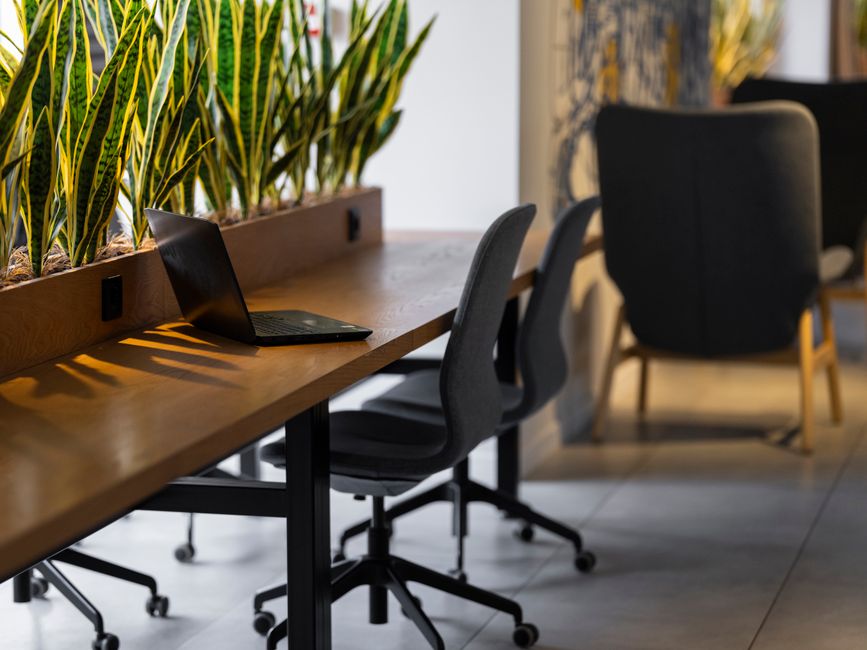
The Palmington‘s 8-desk layout is deliberately configured for exactly this kind of work. The space is exclusively quiet — not a café environment, not an open-plan floor with noise spillover. Individual ergonomic workspaces and full air conditioning mean the physical environment meets the standards described above, without requiring members to bring their own equipment or adapt to substandard furniture.
What Does the Lekki Co-Working Infrastructure Checklist Look Like for Serious Remote Workers?
Use this checklist when evaluating any co-working space — in Lekki, on the mainland, or anywhere across Lagos. The columns represent the infrastructure categories that determine whether a space is operationally fit for professional use.
| Infrastructure Category | Minimum Acceptable Standard | Premium Standard | The Palmington Benchmark |
|---|---|---|---|
| Internet Type | Shared broadband (50 Mbps shared) | Dedicated fiber (uncontended) | Fast, reliable dedicated fiber service |
| Backup Power | Generator present (switchover unspecified) | Industrial generator + UPS on network equipment | Fully powered environment; air conditioning maintained during outages |
| Desk Ergonomics | Standard desk and chair | Adjustable ergonomic chair + dedicated monitor-height desk | Individual ergonomic workspaces per seat |
| Noise Environment | Moderate ambient noise (café-style) | Quiet open plan | Ultra-quiet, exclusive professional environment |
| Operating Hours | Weekday hours (variable) | Fixed weekday hours with clear access policy | Monday–Friday, 9:00 AM–6:00 PM |
| Capacity | Variable (open-plan, unlimited seats) | Capped membership for guaranteed desk access | 8 dedicated desks — fixed, never overcrowded |
| Access Tiers | Daily drop-in only | Daily, monthly, and quarterly access options | Daily (subject to availability), monthly, and 3-month subscriptions |
| Temperature Control | Fans or partial AC | Full air conditioning across all workstations | Fully air-conditioned throughout |
What Are the Essential Connectivity Requirements for Remote Teams Working from Lekki?
Remote teams — whether two founders coordinating across time zones or a distributed team of consultants serving international clients — have connectivity requirements that go beyond what an individual freelancer needs. Below are the non-negotiable infrastructure requirements any lekki coworking space mainland or island-based option must satisfy before a team commits to it as a working base.
- Uncontended fiber line: The internet connection must not be shared with other buildings or throttled during peak hours. Confirm this explicitly with the space operator.
- Stable static IP availability: Teams using VPNs, remote desktop protocols, or corporate security tools often require a static IP address. Confirm availability before signing up.
- Network redundancy: A premium space should have a secondary ISP or LTE failover to maintain connectivity if the primary fiber line experiences a fault.
- Sufficient power outlets per desk: Remote workers typically run a laptop, monitor, phone charger, and sometimes an external hard drive simultaneously. Each workstation needs a minimum of 4 accessible power points.
- Generator rated for full electrical load: The generator must power air conditioning, lighting, and all workstations simultaneously — not just partial load. Confirm the generator’s KVA rating relative to the space’s total electrical draw.
- Zero-interruption network switchover: UPS systems on routers and switches ensure that a grid failure does not drop active calls or disconnect remote desktop sessions even for a second.
- Quiet acoustic environment: Teams on rotating calls throughout the day need a space where one member’s call does not disturb another’s focused work. Open-plan cafés fail this test routinely.
The Palmington‘s 8-person capacity cap is directly relevant here. Because the space never exceeds 8 concurrent users, the dedicated fiber line is never strained, the generator load is always manageable, and the acoustic environment remains consistently quiet — regardless of what time during the 9:00 AM to 6:00 PM operating window you arrive.
How Do Location and Commute Time Affect Your Choice of Co-Working Space in Lagos?
Lagos professionals already know that commute time is a hidden productivity tax. The Third Mainland Bridge during morning rush — particularly between 7:00 AM and 9:30 AM — adds between 45 and 90 minutes each way for workers crossing from the mainland. That is up to three hours of transit time per day before you have done a single hour of billable work.
This is precisely why mainland-based professionals and remote workers who have relocated to Lekki or Victoria Island have increasingly sought co-working options on the island side that eliminate that commute entirely. A lekki coworking space mainland professionals migrate toward must justify the switch not just on amenities, but on time economics.
The Palmington sits at 6 VFC Close, off Meadow Hall Way / Still Waters Garden Estate Road, Ikate, Lekki — a location inside one of Lekki’s established estate corridors. For professionals already residing in Lekki, Ikate, Osapa, or Victoria Island, the access is straightforward without relying on bridge crossings. For those still commuting from the mainland who are evaluating a permanent workspace switch, the calculation is simple: fewer bridge crossings per week translates directly into recaptured productive hours.
The operating hours of Monday to Friday, 9:00 AM to 6:00 PM are also structured around professional norms, not weekend social traffic. If your work is client-driven, deadline-bound, and requires consistent focus from morning to close of business, that structure fits. The Palmington does not operate on weekends, which means the membership profile skews toward serious professionals rather than casual users — reinforcing the quiet environment its members depend on.
If the infrastructure standards and operational environment described in this guide match what you need for your work, the next step is straightforward. Visit The Palmington’s contact page to check desk availability, ask about access tiers, and confirm your start date. With only 8 seats in the space, availability is genuinely limited — and it is the kind of detail worth confirming before you need it most.
Frequently Asked Questions
A shared co-working space assigns no fixed seat — you take whatever desk is free each day. A dedicated desk space reserves a specific workstation for your exclusive use. The Palmington operates 8 dedicated individual ergonomic workspaces, ensuring consistent access to the same setup and network performance every session.
Ask the operator directly: Is the internet line dedicated or shared? What generator capacity do you run, and what is the switchover time? Do you have UPS on your network equipment? Spaces that cannot answer these questions precisely are not built for professional operations. The Palmington runs dedicated fiber with full backup power infrastructure.
The Palmington offers daily access (subject to availability), monthly subscriptions, and 3-month subscriptions. Operating hours are strictly Monday to Friday, 9:00 AM to 6:00 PM. Given the 8-desk capacity cap, contacting the venue directly to confirm availability before your preferred start date is strongly advised.
Yes. Located in Ikate, Lekki, The Palmington eliminates daily Third Mainland Bridge crossings for professionals willing to relocate their work base to the island. Its weekday-only structure, dedicated fiber, and ultra-quiet 8-desk environment are designed specifically for professionals optimising their working hours rather than commute time.