
The best quiet island coworking space in Lagos is The Palmington — an 8-desk boutique workspace on VFC Close, Ikate, Lekki, offering dedicated fiber internet, individual ergonomic workstations, and a structurally enforced noise-free environment for serious remote professionals.
What Internet Speed Do You Actually Need for Remote Work in Lagos?

Bandwidth requirements vary sharply depending on your workflow. A solo freelancer handling email and documents can function on 10 Mbps, but the moment you introduce video conferencing, cloud-based design tools, or concurrent file uploads, the minimum viable threshold climbs to 25–50 Mbps of dedicated, symmetrical bandwidth — meaning equal upload and download speeds. Shared broadband connections in most Lagos cafés and generic open-plan spaces rarely deliver this consistently, especially between 10:00 AM and 2:00 PM when network congestion peaks across the island corridor.
The critical distinction is between dedicated fiber and shared broadband. Dedicated fiber allocates your contracted bandwidth to your connection regardless of how many other users are online. Shared broadband, by contrast, distributes a fixed pipe across all simultaneous users — a pipe that narrows considerably during business hours. For remote workers handling client calls and live deliverables, this is not a minor inconvenience; it is an operational risk.
The Palmington addresses this directly with a dedicated fiber internet service available exclusively during its Monday to Friday, 9:00 AM to 6:00 PM operating window — the precise hours when your productivity output matters most. Because the workspace accommodates only 8 members at full capacity, bandwidth is never diluted across a crowd of strangers.
- Minimum for basic remote work: 10 Mbps symmetrical dedicated connection
- Minimum for video conferencing (HD): 25 Mbps per active user
- Recommended for cloud-heavy workflows: 50 Mbps+ dedicated, not shared
- Critical requirement: Dedicated fiber — not shared broadband or 4G fallback
- Latency target: Sub-20ms ping for real-time collaboration tools
What Amenities Should a Professional Workspace Include?
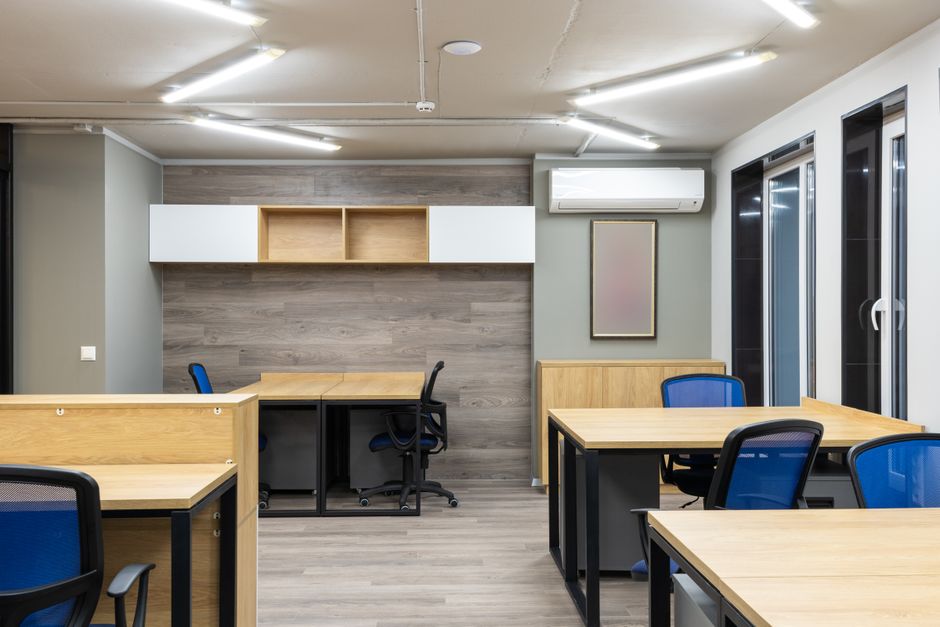
When evaluating any island coworking space Lagos professionals rely on, the amenity checklist separates a productive environment from an expensive distraction. The following infrastructure standards represent the baseline a serious remote worker or freelancer should demand before committing to a subscription.
- Fiber internet: Dedicated, symmetrical connection of at minimum 25 Mbps per active user — not a shared consumer package rebranded as business-grade
- Ergonomic seating: Chairs must provide adjustable lumbar support, seat height, and armrests to sustain posture through an 8-hour workday without physical fatigue
- Desk surface area: A minimum of 120cm × 60cm of clear workspace per person — adequate for a laptop, external monitor, and peripherals without encroachment from neighbouring desks
- Climate control: Individual or zone-controlled air conditioning, not a single wall unit attempting to regulate an entire floor plan
- Power backup: A generator or inverter system capable of sustaining full workspace operations — lighting, air conditioning, and network hardware — through NEPA outages without a perceptible interruption to work
- Noise isolation: Structural separation from street traffic, food vendors, and foot traffic that defines most of Lagos Island’s commercial strips
- Access control: A curated membership model rather than open walk-in access, which is the single most effective noise management mechanism
The Palmington‘s 8-person co-working layout in Ikate is engineered around exactly these standards. The ultra-quiet, exclusive atmosphere is a structural feature, not a policy — enforced by the fact that the space is designed for a maximum of 8 professionals simultaneously, each with individual ergonomic workstations.
What Are the Differences Between Daily, Monthly, and 3-Month Co-Working Subscriptions?
Choosing the wrong access tier is one of the most common and expensive mistakes Lagos-based remote workers make. A daily pass that feels financially low-risk can compound into a monthly spend that exceeds a full subscription by 40–60%. The table below maps the structural logic of each tier against the typical profile of the professional it suits.
| Access Tier | Best Suited For | Cost Structure | Cost-Per-Day Efficiency | Key Consideration |
|---|---|---|---|---|
| Daily Access | Freelancers with irregular schedules; professionals needing a one-off quiet base; out-of-town visitors to the island | Pay-as-you-go; subject to seat availability on the day | Highest cost per day — premium for flexibility | No guaranteed seat; works best for occasional use only. Not viable as a primary workspace strategy. |
| Monthly Subscription | Remote workers with consistent full-time schedules; freelancers with recurring client deadlines | Fixed monthly fee covering all working days within the calendar month | Moderate cost per day — breakeven typically reached after 8–10 visits per month | Guaranteed access; best for professionals who need predictable, bookable space without a long-term commitment. |
| 3-Month Subscription | Fully remote employees; agency freelancers; professionals relocating from VI or mainland avoiding Third Mainland Bridge traffic | Bulk commitment at a discounted total; lowest effective daily rate | Lowest cost per day — maximum savings over the period | Optimal for anyone who has validated that the workspace suits their workflow. Significant Naira savings versus monthly rolling plans. |
One calculation Lagos professionals frequently overlook is the hidden cost of the alternative. A café on Victoria Island or Admiralty Way may appear cheaper per visit, but factor in the cost of unreliable Wi-Fi forcing a mobile data switch, the cognitive tax of ambient noise, and the time lost to commuting to a space that cannot be pre-booked — and the economics of a structured co-working subscription at a venue like The Palmington become straightforward.
How Does Desk Spacing and Noise Isolation Affect Deep Work Productivity?

Cognitive science research on attention and task performance is consistent on one point: ambient noise above 65 decibels measurably impairs accuracy on complex tasks. Open-plan offices with high foot traffic, phone calls, and adjacent conversations routinely exceed this threshold. For professionals billing by deliverable quality — developers, writers, analysts, financial consultants — a noisy environment is not merely uncomfortable. It directly reduces the value of the hours worked.
The standard for deep work infrastructure therefore requires more than a quiet rule posted on a wall. It requires a structural environment where noise is architecturally minimised. Key variables include desk-to-desk clearance of at minimum 90cm to prevent audio spillover from adjacent workstations, a curated capacity limit that prevents the accumulation of parallel conversations, and a location distanced from high-traffic Lagos commercial strips.
Ikate, Lekki — where The Palmington sits on VFC Close, off Meadow Hall Way — positions members away from the gridlock and street-level noise of Admiralty Way and the Lekki-Epe Expressway’s commercial belt, while remaining accessible from Victoria Island and the wider Lagos Island axis without requiring travel across Third Mainland Bridge. For professionals based on the island, this geography alone eliminates a significant daily productivity tax.
Ergonomic desk spacing at The Palmington’s 8-desk layout means each member occupies a genuine individual workstation — not a hot-desk squeezed between a phone-loud neighbour and a communal printer. The air-conditioned environment remains stable throughout the day, removing the physical discomfort variable that degrades concentration during Lagos afternoons.
What Should You Know About Power Backup Before Choosing a Co-Working Space in Lagos?
NEPA outages remain a non-negotiable operational consideration for any Lagos-based workspace evaluation. A co-working space that loses power — and therefore loses internet, air conditioning, and lighting — mid-workday is functionally unusable regardless of how well it photographs on Instagram. The backup power question should be asked explicitly before signing any subscription agreement.
The minimum acceptable standard for a professional workspace in Lagos is a generator or inverter system capable of sustaining all critical systems simultaneously: climate control, network hardware, and workstation power. A space that can keep the lights on but loses its router during an outage provides no real protection. Equally, a space with generator backup but no automatic switchover — leaving members sitting in a dark, warming room for two to five minutes during transition — disrupts the uninterrupted workflow that justifies the subscription cost.
When evaluating an island coworking space in Lagos, treat power backup continuity as a non-negotiable infrastructure requirement, not a bonus feature. Ask specifically: Does backup power cover the air conditioning units? Does the network stay live during the switchover? How long can the backup system sustain full operations during an extended outage?
If you are ready to work from a space that treats connectivity, ergonomics, and operational reliability as foundational standards rather than marketing claims, The Palmington is available for daily access, monthly subscriptions, and 3-month plans. Reach out directly via thepalmington.com/contact to check seat availability and secure your workspace in Ikate, Lekki.
Frequently Asked Questions
The Palmington in Ikate, Lekki is a purpose-built 8-desk island coworking space in Lagos offering dedicated fiber internet, individual ergonomic workstations, and full air conditioning in an exclusively quiet environment — available weekdays from 9:00 AM to 6:00 PM. It serves remote workers and freelancers across the Lagos Island corridor.
Daily co-working rates in Lekki vary by venue and amenity tier. Premium dedicated-fiber spaces with guaranteed individual workstations typically carry higher per-day costs than casual café arrangements. Monthly and 3-month subscriptions at venues like The Palmington reduce the effective daily cost significantly and guarantee seat availability.
A professional Lagos co-working space should provide a minimum of 25 Mbps symmetrical dedicated fiber per active user — not shared broadband. For video-heavy or cloud-intensive workflows, 50 Mbps+ dedicated is the practical standard. Shared broadband packages degrade sharply during peak business hours and are not adequate for reliable remote work.