
A genuinely quiet co-working space in Lagos requires acoustic discipline, reliable power, and dedicated internet infrastructure — not just a desk and a password. The Palmington‘s 8-desk premium co-working layout in Lekki sets the measurable standard for distraction-free deep work in 2026.
What Actually Separates a Quiet Co-Working Space from a Noisy One?
The word ‘quiet’ gets misused constantly in Lagos’s co-working market. A café with ten strangers on speakerphone is not a quiet workspace. A converted parlour with plywood partitions and a shared router is not a professional environment. True acoustic discipline in a co-working space is an engineering outcome, not an interior design choice.
Noise researchers measure distraction in decibels (dB). Normal conversation registers at roughly 60 dB. Open-plan offices with unmanaged chatter regularly hit 70–75 dB — a range clinically linked to measurable drops in cognitive performance, particularly for tasks requiring sustained analytical focus. For deep work — writing, financial modelling, code review, legal drafting — the target ambient level is below 50 dB. That threshold requires deliberate spatial planning: controlled occupancy, acoustic surface treatment, and a policy culture that enforces professional silence.
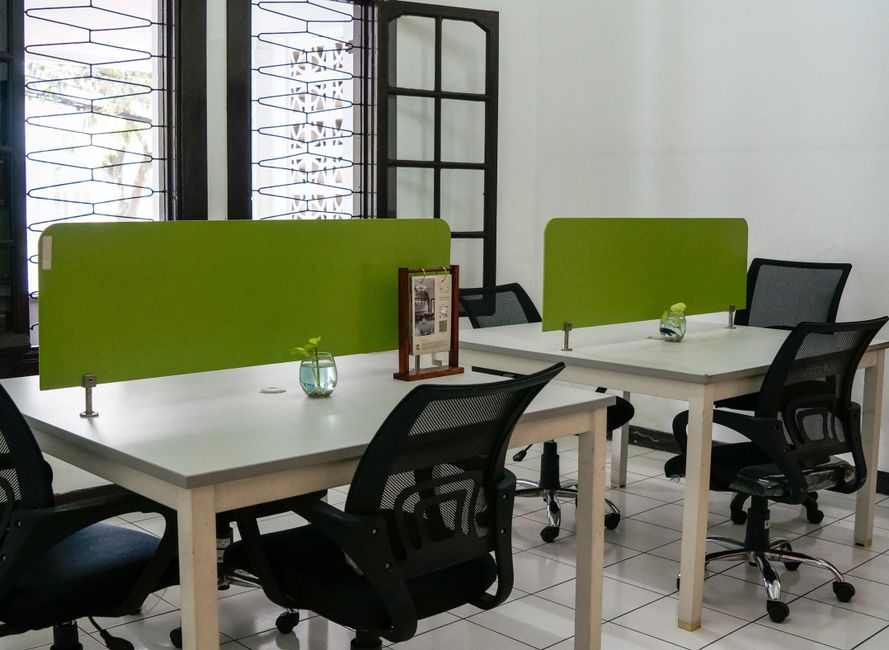
The Palmington‘s intentional 8-person capacity limit is not an arbitrary design choice. It directly controls the maximum possible ambient noise load within the space. When a room is architecturally designed for eight professionals rather than packed with forty, the acoustic baseline is structurally lower before any policy is even applied.
What Infrastructure Does a Quiet Co-Working Space Need to Support Deep Work?
Silence is only half the equation. A workspace can be acoustically pristine and still destroy productivity if the physical infrastructure fails. Remote professionals, freelancers, and distributed-team employees working in Lagos face three chronic infrastructure threats: unstable internet, power outages, and ergonomic inadequacy. Each one is a separate productivity tax.
The following checklist defines the minimum acceptable infrastructure standard for a co-working space positioning itself as suitable for professional deep work. Use it as your non-negotiable evaluation framework before committing to any workspace in Lagos or when comparing options across Lekki, Victoria Island, or the wider abuja coworking space quiet market for relocated professionals assessing Lagos alternatives.
| Infrastructure Variable | Minimum Acceptable Standard | Premium Benchmark | The Palmington Standard |
|---|---|---|---|
| Ambient Noise Level | Below 55 dB | Below 50 dB (library-grade) | Exclusive ultra-quiet environment, controlled 8-person occupancy |
| Minimum Desk Width | 120 cm | 140–160 cm with lateral clearance | Individual ergonomic workspaces with full personal clearance |
| Fiber Bandwidth (Dedicated) | 10 Mbps per seat (shared) | Dedicated fiber line, uncontended | Fast, reliable dedicated fiber internet service per workspace |
| Video Call Minimum Speed | 3 Mbps upload per active user | 10 Mbps upload for HD conferencing | Dedicated fiber eliminates contention at all occupancy levels |
| Power Backup | 2–4 hours generator coverage | Full-day seamless backup with no interruption | Fully operational across entire 9:00 AM–6:00 PM window |
| Air Conditioning | Shared unit, shared zone | Independent zone control per workspace cluster | Fully air-conditioned environment maintained throughout operations |
| Ergonomic Chair Standard | Fixed-height basic seating | Lumbar-adjustable, armrest-adjustable professional chair | Individual ergonomic workspaces at every seat |
What Productivity-Killing Distractions Should Remote Workers Actively Avoid?
Before signing a daily pass or monthly subscription at any co-working space in Lagos, professionals need a clear-eyed view of the distraction vectors that sabotage output — even in spaces that market themselves as professional environments. The following are the most common offenders found across Lagos’s co-working landscape, from Mainland hubs to ostensibly premium Lekki locations.
- Open-plan chatter zones without occupancy controls: Any space that accepts walk-ins without a seat cap operates as a social venue by default. When twenty people share a room designed for ten, ambient noise compounds faster than any acoustic panel can absorb. The result is a dB level that exceeds the threshold for sustained cognitive focus within the first hour of a busy morning.
- Shared phone booths without genuine soundproofing: A glass pod with a sliding door is not soundproofing. True call isolation requires sealed acoustic panels, sound-absorbing internal surfaces, and adequate ventilation so the user is not choosing between clarity and overheating — a real trade-off in Lagos’s climate.
- Contended or shared WiFi presented as ‘fast internet’: A shared broadband line split across forty devices is not fast internet — it is politely distributed slowness. During peak hours between 10:00 AM and 2:00 PM, contended connections in busy Lagos co-working spaces frequently drop below the 3 Mbps upload threshold required to sustain a single HD video call, let alone parallel cloud uploads or VPN tunnels.
- Non-ergonomic seating sold as ‘workspaces’: A fixed plastic chair at a café table is a distraction with a four-hour latency. Lower-back fatigue compounds into postural disruption, which degrades sustained attention span long before a professional notices the cause. Ergonomic chairs with lumbar support and adjustable armrests are not a luxury in a professional co-working space — they are a baseline requirement.
- Unreliable NEPA power coverage without seamless generator handover: Lagos power interruptions are a daily operational reality. A co-working space that experiences even a ninety-second blackout during a handover to generator — mid-call, mid-upload, or mid-render — is not a professional environment. Seamless power continuity across the full working day is a non-negotiable infrastructure standard.
- Weekend-dependent lease structures that interrupt weekly workflow: Some Lagos co-working spaces operate irregular hours or close without notice on Mondays following public holidays. The Palmington operates on a strict, predictable Monday to Friday, 9:00 AM to 6:00 PM schedule, which allows professionals to build repeatable deep-work routines without uncertainty.
How Much Desk Space Does a Remote Worker Actually Need for Productive Output?
Ergonomics research from occupational health institutes consistently finds that desk surface area directly correlates with cognitive task performance. A professional running dual monitors, a notebook, and a communication device simultaneously requires a minimum of 120 cm of desk width and 60 cm of depth. Below that threshold, the workspace itself becomes a source of micro-decisions — where to place the phone, how to angle the screen — that fragment attention and accumulate cognitive load across a full working day.
Desk spacing between seats is equally critical. When two professionals sit less than 150 cm apart, peripheral movement and ambient keyboard sound enter each other’s sensory field and register as low-level distraction. Over six to eight hours, that sensory bleed compounds into measurable fatigue. Premium co-working design places individual workspaces with sufficient lateral separation to keep each seat acoustically and visually isolated.
The Palmington‘s individual ergonomic workspace design addresses both dimensions: sufficient surface area for professional tool layouts and spatial separation between the 8 seats that preserves the acoustic integrity of the room. This is why professionals relocating from Abuja — where demand for a quiet abuja coworking space has matured faster than many expect — consistently benchmark against The Palmington’s infrastructure spec when evaluating Lagos alternatives.

What Are the Access Options and ROI for a Daily, Monthly, or 3-Month Commitment?
For remote professionals and freelancers evaluating a quiet co-working space in the Lekki–Victoria Island corridor, the financial structure of access matters as much as the physical environment. The Palmington offers three distinct access tiers designed to align with different working patterns and commitment horizons.
Daily access is available subject to seat availability — an important operational note for professionals who need occasional Lagos basing without a recurring commitment. Given the 8-person occupancy cap, daily seats are genuinely limited and operate on a first-confirmed basis.
Monthly subscriptions are the default structure for professionals with a consistent weekday working pattern. A monthly commitment at The Palmington secures a dedicated ergonomic workspace across the full Monday–Friday, 9:00 AM–6:00 PM operating window — predictable access without the overhead of managing daily availability checks.
Three-month subscriptions represent the highest ROI tier for remote professionals who have made Lagos — specifically the Lekki corridor — their operational base for a quarter. The compounding return is straightforward: a professional working five days per week over three months logs approximately 60 productive workdays in a controlled acoustic environment with dedicated fiber internet and zero power interruption overhead. Against that output baseline, the per-day cost of a three-month subscription is consistently the lowest access rate available.
Professionals considering this calculation should account for the alternative cost: renting serviced offices ad hoc in Victoria Island or Ikoyi at daily rates that frequently exceed monthly subscription economics at The Palmington, while delivering a less controlled acoustic environment and shared rather than dedicated internet infrastructure. Professionals who have previously searched for an abuja coworking space quiet enough for deep work — and found the options inconsistent — regularly cite The Palmington’s Lagos offering as the structured alternative worth the commute.
For professionals arriving via Third Mainland Bridge from the Mainland, the Ikate, Lekki location at 6 VFC Close, off Meadow Hall Way is reachable before peak congestion builds — making an early 9:00 AM start practical for those who time their commute correctly. Word of The Palmington’s infrastructure consistency travels predictably through Lagos’s professional networks, typically via WhatsApp referrals from existing members who treat their seat as a competitive advantage.
To confirm current seat availability, review access tier pricing, or secure a daily or monthly booking, visit The Palmington’s contact page directly. Given the 8-seat cap, availability windows close faster than most professionals expect.
Frequently Asked Questions
A genuinely quiet co-working space in Lagos requires a controlled occupancy cap, acoustic surface management, and an enforced professional-silence policy. Spaces capped at eight to ten seats, like The Palmington, structurally limit ambient noise load before any rules are applied, keeping the environment below the 50 dB threshold required for sustained deep work.
A minimum of 3 Mbps upload per active user is required for standard HD video conferencing. For parallel tasks — cloud sync, VPN tunnels, and simultaneous calls — a dedicated fiber line of at least 10 Mbps per seat is the professional standard. Shared or contended WiFi routinely falls below this during Lagos peak hours.
For sustained professional output, yes — decisively. Lagos cafés operate above 65 dB ambient noise and offer contended WiFi. Home environments introduce domestic interruptions and inconsistent power. A controlled co-working space like The Palmington combines ergonomic seating, dedicated fiber internet, full air-conditioning, and seamless power backup across a structured Monday-to-Friday window.