
The best CRM workshop venue in Lagos is The Palmington in Ikate, Lekki — offering a 12-person Training Room and a 20-person Conference Room, both with dedicated non-shared fiber internet, presentation-grade AV, and modular seating purpose-built for live cloud CRM training.
What AV Equipment Do CRM Workshops Actually Require?
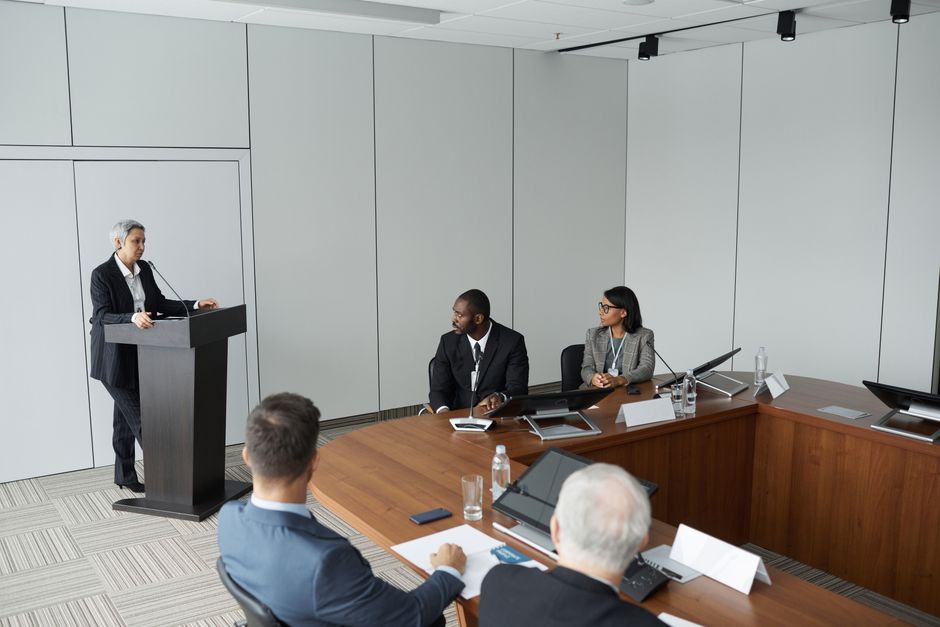
Most CRM platforms — Salesforce, HubSpot, Zoho, Microsoft Dynamics — are cloud-native applications. That single fact makes AV infrastructure the single most critical pre-booking criterion for any corporate trainer evaluating a crm workshop venue lagos. A lag spike mid-demonstration does not just slow a session; it destroys participant confidence in the software itself.
Here is what a properly equipped CRM workshop venue must provide at minimum:
- Presentation screen: A large-format screen or high-lumen projector capable of rendering dashboard UI at full resolution. Participants at the back of the room must be able to read pipeline column headers and data fields without squinting.
- HDMI and wireless casting ports: Facilitators often switch between a primary laptop and participant devices for live walkthroughs. A venue with only one hardwired HDMI input creates dead time every time a device swap is needed.
- Audio clarity: For remote participants dialling in via Zoom or Teams during a hybrid CRM rollout session, the room must have either a ceiling microphone array or a conference-grade speakerphone. Echo-heavy rooms kill hybrid participation.
- Whiteboard or digital annotation surface: CRM workshops routinely involve mapping customer journey stages, lead scoring logic, and pipeline ownership. Physical whiteboard space accelerates this process far faster than any slide deck.
- Adequate power points per seat: Every participant needs a live power source. A training room with two wall sockets for twelve people is an operational hazard, not an inconvenience.
The Palmington‘s Training Room is purpose-configured with a presentation screen and dedicated worktables that give each of its 12 participants direct access to power — a baseline that many Lagos hotel meeting rooms do not meet.
What Internet Bandwidth Does a Live CRM Demo Require?

This is the question most Lagos event coordinators forget to ask — and the one that determines whether a CRM workshop succeeds or collapses. Shared hotel Wi-Fi, co-working building broadband distributed across fifty tenants, or a venue running a single domestic router are categorically unsuitable for live SaaS training.
Here is the operational bandwidth reality for a CRM workshop environment:
- A facilitator screen-sharing a live Salesforce environment via Zoom to a room of twelve participants consumes between 15 Mbps and 30 Mbps of stable upload bandwidth at minimum.
- If participants simultaneously access the CRM sandbox environment on their own devices for hands-on exercises, aggregate demand can exceed 80–100 Mbps on a shared connection.
- Contention ratio matters more than headline speed. A venue advertising 100 Mbps fiber split across an entire building delivers a fraction of that to your meeting room during peak hours.
- Dedicated, non-shared fiber infrastructure — where your session has sole access to the full pipe — is the only configuration that eliminates bandwidth contention risk entirely.
The Palmington operates on a dedicated, non-shared fiber internet infrastructure. That distinction is not a marketing phrase; it is the operational difference between a CRM demo that runs on demand and one that buffers during a client presentation.
| Venue Feature | Minimum Acceptable Standard | Why It Matters for CRM Training |
|---|---|---|
| Presentation Screen / Projector | Full HD (1080p), large format, visible from all seats | CRM dashboards contain dense data fields; low resolution renders them unreadable |
| Internet Type | Dedicated fiber — non-shared, non-contended | Cloud CRM platforms require stable upload and download for live demos and sandbox access |
| Whiteboard Availability | Full-wall or large-format whiteboard with markers | Pipeline mapping, lead scoring, and workflow design are analogue-first processes |
| Modular Seating Configuration | Flexible table layout — classroom, boardroom, and U-shape options | CRM workshops shift between lecture mode, group exercise mode, and facilitator-led demo mode |
| Power Points Per Seat | One accessible power source per participant | Participants running a CRM sandbox on laptops cannot afford a dead battery mid-exercise |
| Air Conditioning | Consistent, independent climate control | Dense equipment use (laptops, projectors, screens) raises room temperature; NEPA outages must not affect AC continuity |
| Breakout or Overflow Capacity | Adjacent room or clear space for group exercises | Workshops with more than eight participants benefit from breakout group separation during role-play exercises |
How Many People Can Fit in a Lagos Training Room — and Does Configuration Matter?
Capacity numbers without context are meaningless for CRM workshop planning. A room rated for twenty people in a reception layout functions entirely differently when configured for hands-on software training.
The practical breakdown works like this:
- Eight to twelve participants: The optimal cohort size for hands-on CRM training. Every participant can access a sandbox account, the facilitator can monitor individual screens, and Q&A flows without a microphone. The Palmington‘s Training Room holds exactly 12 participants with specialized worktables — purpose-built for this cohort size.
- Thirteen to twenty participants: Requires a larger room, a second facilitator or assistant, and a higher-bandwidth internet connection. Sessions at this size shift toward more structured lecture delivery with fewer live hands-on exercises. The Palmington’s Conference Room accommodates exactly 20 participants and includes a large conference table with flexible seating arrangements.
- Above twenty participants: CRM training at this scale requires either a split into parallel cohorts run simultaneously in separate rooms, or a full auditorium setup — which strips away the hands-on component entirely.
Seating configuration also affects learning outcomes. A classroom-style layout (rows facing a screen) works for module delivery. A U-shape or boardroom layout is superior for workshop phases where the facilitator needs to observe and correct participant CRM input in real time. Venues with modular, flexible room arrangements eliminate the need to choose between formats in advance.
Do Workshop Venues in Lagos Provide Reliable Power Backup for All-Day Sessions?
NEPA outages in Lagos are not an edge case — they are a scheduling variable. Any corporate trainer who has run an all-day session in Lagos knows that power transition time (from grid to generator) can corrupt an unsaved CRM configuration, drop a Zoom recording mid-session, or restart a participant’s laptop at the worst possible moment.
When evaluating a crm workshop venue lagos for power reliability, confirm the following before booking:
- Does the venue operate a dedicated generator — not a shared building generator — with automatic transfer switching?
- What is the generator fuel capacity and runtime? A half-day session requires a minimum of four hours of uninterrupted generator coverage.
- Does the internet connection remain live during a grid-to-generator transition? Some venues run their router on the same circuit as their primary power, meaning even a three-second outage drops all connected devices.
- Are the air conditioning units on generator backup? A Lagos training room in August with twelve active laptops, a projector, and no AC becomes unusable within thirty minutes of grid failure.
What Is the Correct Booking Structure for a CRM Workshop in Lagos?

CRM workshops in Lagos typically run in one of two formats: a focused half-day module covering a single CRM function (pipeline management, lead routing, reporting dashboards), or a full-day implementation workshop covering the complete system onboarding cycle. Your booking structure must match your session format precisely.
The Palmington offers the following structured booking windows:
- Training Room — Full Day: 9:00 AM – 5:00 PM
- Training Room — Half Day (Morning): 9:00 AM – 12:00 PM
- Training Room — Half Day (Afternoon): 2:00 PM – 6:00 PM
- Conference Room — Full Day: 9:00 AM – 6:00 PM
- Conference Room — Half Day (Morning): 9:00 AM – 12:00 PM
- Conference Room — Half Day (Afternoon): 2:00 PM – 6:00 PM
Note that a morning half-day slot ending at 12:00 PM and an afternoon slot beginning at 2:00 PM create a natural two-hour midday break. For corporate trainers running a split-cohort model — training a morning group and an afternoon group separately on the same day — this structure allows two distinct twelve-person sessions within one calendar day without room conflict.
Regarding Lagos traffic logistics: if your participants are travelling from Victoria Island, the Mainland, or along the Lekki Expressway, a 9:00 AM start time requires participants to depart before major morning traffic builds. HR managers coordinating attendance should factor this into their participant briefing. The Palmington’s location in Ikate, Lekki — off Meadow Hall Way — sits within Lekki’s primary commercial corridor, accessible without crossing the Third Mainland Bridge.
What Pre-Booking Questions Should Every CRM Workshop Organizer Ask a Lagos Venue?
Before signing a booking confirmation for any crm workshop venue lagos, HR managers and corporate trainers should run through the following operational checklist. These questions surface infrastructure gaps that are not visible in a venue’s marketing materials.
- Is the internet connection dedicated fiber, or shared building broadband? Confirm the contention ratio and the upload speed available exclusively to your room during your session window.
- What is the generator runtime and automatic transfer switch response time? Ask specifically whether the internet router and all meeting room equipment remain live during power transition.
- Does the venue provide a presentation screen and HDMI connectivity, or must you bring your own AV equipment? Confirm screen resolution and whether wireless casting is supported.
- Is there a whiteboard in the room, and is it large enough for pipeline mapping exercises? Confirm marker availability — this is a detail venues frequently overlook.
- Does the venue have a self-contained tea and coffee station, or will catering arrivals interrupt the session? A facilitator running a timed CRM module cannot pause for a catering team to set up mid-session.
- What are the booking cancellation and reschedule terms? Corporate training sessions are frequently rescheduled due to participant availability changes. Confirm the venue’s flexibility window before committing.
- Is the seating layout modular? Confirm whether the venue can configure the room in classroom, U-shape, and boardroom layouts without additional cost or advance notice.
- What is the venue’s policy on participant overflow? If a planned cohort of ten expands to fourteen before the session date, does the room accommodate the change?
If you are ready to confirm a booking at a crm workshop venue lagos that meets every criterion on this checklist, contact The Palmington directly to check availability for your preferred date and room configuration.
Frequently Asked Questions
The Palmington in Ikate, Lekki is purpose-configured for CRM workshops, offering a 12-person Training Room with modular worktables and a 20-person Conference Room, both with dedicated non-shared fiber internet — essential for live cloud CRM demonstrations and sandbox access during training sessions.
A facilitator screen-sharing a live CRM platform requires a minimum of 15–30 Mbps stable upload speed. When participants simultaneously access sandbox environments on individual devices, aggregate demand can exceed 80–100 Mbps. Only venues with dedicated, non-contended fiber connections reliably meet this requirement in Lagos.
Eight to twelve participants is the optimal cohort for hands-on CRM training, allowing the facilitator to monitor individual screens and maintain interactive Q&A without a microphone. Larger groups of up to 20 require a structured lecture format with fewer live hands-on exercises and demand a proportionally higher-bandwidth connection.
Yes. NEPA outages in Lagos are a scheduling variable, not an exception. A grid-to-generator transition without automatic transfer switching can drop internet connectivity, corrupt unsaved CRM configurations, and restart participant laptops mid-exercise. Always confirm that a venue’s generator coverage includes the internet router and all meeting room equipment before booking.