
A coordinated reception venue in Lagos provides synchronized catering zones, structured decorator access, secured gift storage, and defined vendor staging — all under one roof. The Palmington in Ikate, Lekki, is Lagos’s benchmark for this exact multi-vendor operational standard.
What Infrastructure Do Caterers Actually Need at a Lagos Reception Venue?
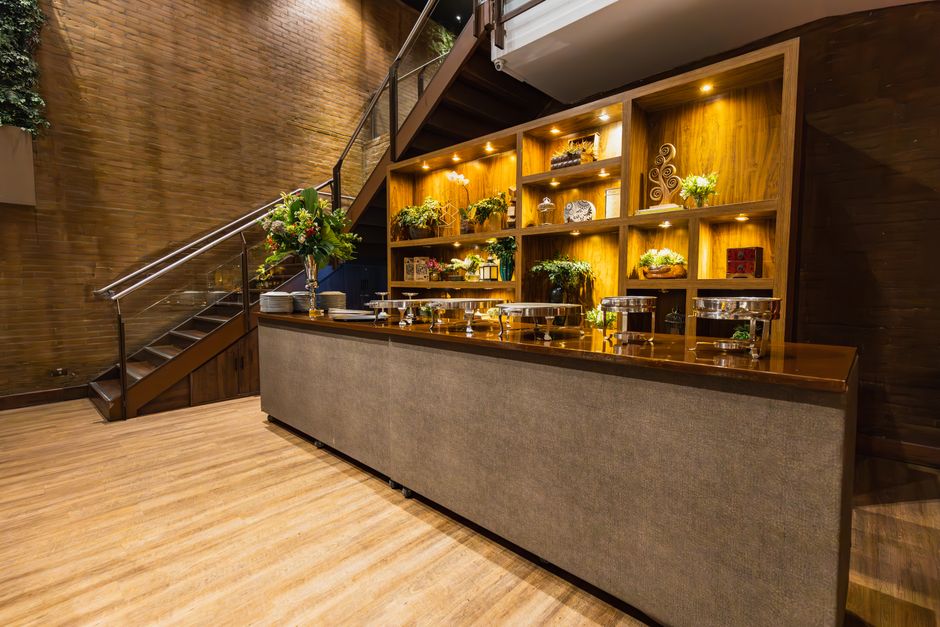
Catering teams are among the heaviest infrastructure consumers at any reception. They arrive early, require significant power draw for warming equipment, need running water at multiple points, and demand a clear exit path for waste and spent equipment — all without crossing into guest-facing zones.
A venue that lacks a dedicated catering prep area forces teams to set up in guest corridors, parking zones, or worse, inside the hall itself before it is dressed. This creates a logistical collision between vendor activity and the decorator’s setup window. At minimum, a coordinated reception venue lagos couples rely on must provide:
- Dedicated outdoor prep and wash-up zones separate from the guest arrival path
- Multiple running water access points to support simultaneous cooking, plating, and cleaning operations
- Electrical sockets rated for commercial catering equipment distributed across the outdoor area
- Defined entry and exit lanes for food service that do not intersect with guest seating rows
- Grill areas positioned downwind and away from air-conditioned indoor spaces to prevent smoke ingress
- Generator backup capacity sufficient to sustain food warmers, fridges, and bar chillers simultaneously throughout the event
In practice, Lagos caterers operating without these provisions will improvise — and improvisation at a 220-guest reception produces bottlenecks, cold food, and compromised hygiene standards. The Palmington‘s outdoor turf infrastructure was designed with exactly these operational realities embedded into the layout, including grill areas, outdoor wash-up zones, and distributed electrical sockets across the turf perimeter.

How Do Decorators Access Setup Zones Without Disrupting Guest Arrival?
Decorator access timing is one of the most frequently mismanaged elements at Lagos receptions. The core conflict is simple: decorators need unobstructed, early access to every surface — ceiling rigging points, chair rows, table centrepieces, backdrop frames, and floral installations — while venue staff are simultaneously preparing the space and early guests may already be trickling in.
The standard operational sequence that separates a coordinated reception venue from a casual hire space is a strict, staged timeline:
- Venue inspection and handover — decorator lead and venue manager walk the space together before any item is offloaded. Every rigging point, power socket, and restricted zone is confirmed.
- Structural installations first — backdrops, arches, ceiling drapes, and heavy frames go up before any furniture is placed, so no chair or table is moved twice.
- Furniture dressing window — table linen, centrepieces, and chair covers are applied only after structural work is complete and signed off.
- Detail finishing and photography window — final floral drops, lighting adjustments, and table card placements happen in the last hour before guest arrival.
- Decorator team exit or holding position — at guest arrival, decorator staff transition to a holding zone or exit entirely, eliminating the visual of ladders and tool bags during the reception.
Venues that permit a single shared entry point for both decorators and arriving guests collapse this sequence entirely. A decorator van offloading arch pipes through the same gate where guests are stepping out of their cars is a coordination failure, not a minor inconvenience.
The caution deposit system — standard across professional Lagos venues — enforces accountability at this stage. When a decorator pays a ₦60,000 caution deposit as at The Palmington‘s current standard, it creates a contractual checkpoint that ensures the team respects the timeline, restores the venue fabric after installation, and operates within the agreed access window.

What Security Protocols Protect Gifts and Valuables at Coordinated Venues?
Gift management is rarely discussed during venue tours but consistently surfaces as a pain point after events. At a Lagos reception with 100 to 220 guests, the volume of cash envelopes, wrapped gifts, and small valuables accumulating at the gift table over a four-to-six-hour event is substantial. Without a secured, supervised storage solution, gifts migrate — by accident, by opportunism, or by simple crowd chaos near the gift station.
A coordinated reception venue must provide at minimum:
- A dedicated, lockable gift and valuables room that is physically separated from the main hall and turf
- A single responsible access point for the gift room — ideally managed by the couple’s designated family representative, not a rotation of well-meaning guests
- A staging table outside the room where gifts are received, logged, and then moved inside — preventing the gift table from becoming an unsupervised accumulation point
- Clear sightlines from the gift area to the host table so the couple is always aware of activity near their valuables
- Venue staff or security personnel assigned to the corridor adjacent to the gift room for the full duration of the event
The Palmington‘s ensuite changing and gift-storage room attached to the indoor hall is a direct architectural response to this operational requirement. It functions as a secure holding zone for envelopes, wrapped gifts, and personal items belonging to the couple — accessed only by the designated handler, not the general guest flow.
How Much Generator Capacity Does a Multi-Vendor Reception Actually Require?
NEPA reliability in Lekki is not a planning variable — it is a constant risk. Any reception venue operating without a generator agreement baked into the hire terms is handing the couple an unbudgeted crisis. The question is not whether backup power is needed, but whether the generator capacity matches the actual vendor power draw at peak event load.
At a fully staffed reception with 150 to 220 guests, the simultaneous power demand typically includes:
- Air conditioning units sustaining an indoor hall of 90 seated guests
- DJ or live band amplifier stacks and stage lighting
- Catering warmers, fridges, and bar chillers
- Photographer and videographer battery charging stations
- Outdoor decorative lighting, fairy light installations, and neon signage
- Photo booth equipment and printer stations
- PA system microphones and wireless receivers for the MC
A generator sized only for indoor air conditioning will fail the caterer’s equipment and the DJ simultaneously the moment NEPA cuts. The operational standard is a generator sized to the full combined load — indoors and outdoors — for the entire event window. For half-day bookings, a minimum of 3 hours of generator backup is the industry floor. For full-day bookings running from 9:00 AM to Midnight, 8 hours of backup capacity is the coordinated infrastructure standard — which is exactly the specification The Palmington builds into its full-day booking terms.
What Does a Vendor Coordination Checklist Look Like for a Lagos Reception?
| Vendor Type | Infrastructure Requirement | Timeline Window | Caution Deposit Standard |
|---|---|---|---|
| External Caterer | Running water points, wash-up zones, grill area, outdoor electrical sockets, covered prep space | Minimum 2 hours before guest arrival; exit 1 hour after food service closes | ₦50,000 refundable caution deposit |
| External Decorator | Ceiling rigging access, unobstructed floor plan, power sockets for lighting rigs, lockable tool staging area | Minimum 3–4 hours before guest arrival for full installations; 1 hour post-event for breakdown | ₦60,000 refundable caution deposit |
| DJ / Live Band | Dedicated stage or performance zone, dedicated high-load electrical circuit, clear sightline to dance floor | Setup 90 minutes before guests arrive; soundcheck completed before hall opens | Covered under venue hire terms; equipment damage liability on vendor |
| Photographer / Videographer | Battery charging access, changing room access for costume changes, unobstructed angles from key positions | Present from venue handover through to last dance | No caution deposit; access managed by couple’s coordination team |
| Photo Booth Operator | Dedicated power socket, minimum 3m × 3m floor space away from main traffic flow, printer ventilation clearance | Setup 1 hour before guests arrive; operational from cocktail hour onward | Covered under decorator or separate vendor agreement |
| Bar / Drinks Vendor | Refrigeration power socket, ice storage area, proximity to wash-up zone, waste bin clearance access | Setup 1.5 hours before guest arrival; bar sealed 30 minutes before event close | Covered under caterer caution if same operator; separate ₦50,000 if independent |
What Coordination Failures Most Commonly Ruin Lagos Receptions?
The difference between a reception that flows and one that visibly collapses in front of 200 guests is almost always traceable to a specific infrastructure gap identified — too late — during the event itself. These are the failures that experienced Lagos planners have catalogued across hundreds of events:
- Single-entry bottlenecks: One gate or door shared by arriving guests, vendor offloading teams, catering carts, and decorator vans creates a physical standstill that delays every timeline simultaneously. Guest arrivals feel chaotic, vendors are frustrated, and the decorator’s setup clock is already running short.
- No dedicated catering prep zone: Without a separated prep area, caterers colonise whatever space is available — usually the edge of the guest zone. Food smells, gas burner heat, and catering noise intrude on the reception ambience before the couple even arrives.
- Inadequate generator capacity for vendor equipment: A generator sized only for indoor lighting fails the moment the DJ amplifiers, catering warmers, and bar fridges all draw simultaneously. The result is a power brownout mid-reception — a coordination failure with no quiet fix.
- Absent or insecure gift storage: A gift table in the open hall with no supervised secure room means envelopes disappear into crowd movement. This is not hypothetical; it is a documented pattern at Lagos receptions operating without a dedicated gift room.
- No decorator breakdown plan: When decorators have no agreed post-event window or staging area for breakdown equipment, they dismantle arches and pull linen while guests are still seated. The visual effect destroys the closing atmosphere of the event.
- Overlapping indoor and outdoor vendor flows: When catering traffic, guest movement, and decorator access all share the same corridor or entrance, the event loses spatial coherence. Indoor guests and outdoor turf guests operate in different sensory environments — the venue must support both simultaneously without collision.
- No separated restroom allocation: Sharing a single set of restrooms between 220 guests across indoor and outdoor zones creates queues that pull guests away from the programme and generates complaint chains via WhatsApp referral groups long after the event closes.
How Does Indoor-to-Outdoor Guest Flow Architecture Affect Reception Coordination?
Guest flow architecture is the invisible infrastructure of a well-run reception. When 90 guests are seated indoors in an air-conditioned hall and 120 guests are seated on an enclosed outdoor turf simultaneously, the venue must sustain two fully operational environments — not one primary space and one overflow area.
This separation has direct implications for vendor coordination:
- Catering teams must be able to service both zones without crossing through one guest area to reach the other
- The MC’s PA system must cover both indoor and outdoor zones with appropriate volume levels for each environment
- Restrooms must be allocated per zone — not pooled — to prevent cross-zone traffic that disrupts the flow of both areas
- Decorative lighting design must account for the different ambient conditions: indoor controlled light versus outdoor evening natural and artificial light
- The couple’s movement between zones must follow a choreographed path that is communicated to all vendor leads before the event opens
The Palmington‘s design achieves this separation operationally: the indoor hall accommodates ~90 seated guests with full air conditioning, a mirrored selfie-wall, and direct access to the ensuite changing and gift-storage room, while the outdoor artificial turf accommodates ~120 seated guests with dedicated ladies’ and gents’ restrooms, distributed electrical sockets, grill areas, and multiple running water points — each zone independently serviced by vendors without requiring cross-zone traffic.
For couples and planners finalising their search for a coordinated reception venue in Lagos, The Palmington represents the complete operational package: a ₦60,000 external decorator caution, a ₦50,000 external caterer caution, a secured ensuite gift-storage room, 3 hours of generator backup on half-day bookings and 8 hours on full-day bookings, and a separated indoor-turf flow that keeps vendor operations invisible to guests throughout. To confirm availability or discuss your specific vendor coordination requirements, contact the team directly at thepalmington.com/contact.
Frequently Asked Questions
A truly coordinated reception venue provides separated catering prep zones, structured decorator access timelines, secured gift storage, distributed power sockets, and a generator sized for full vendor load. Without these, vendors improvise — and improvisation at scale produces visible operational failures during the event.
Caution deposits vary by venue and vendor type. At The Palmington in Lekki, the standard external caterer caution is ₦50,000 and the external decorator caution is ₦60,000, both refundable upon satisfactory venue restoration. These deposits enforce timeline compliance and protect the venue infrastructure.
It depends entirely on generator sizing. Many Lagos venues provide backup power only for indoor air conditioning, leaving DJ rigs, catering warmers, and bar chillers unprotected during a NEPA outage. A coordinated venue like The Palmington provides up to 8 hours of full-capacity generator backup on full-day bookings, covering both indoor and outdoor vendor loads.