
The best hybrid meeting venue in Lagos is one that provides dedicated fiber internet, professional AV, and automatic generator backup — not shared building Wi-Fi. The Palmington Conference Room in Ikate, Lekki, meets every one of these requirements as a purpose-built facility.
What Does a Hybrid Meeting Actually Require from a Lagos Venue?
Most Lagos professionals confuse a room with a screen for a hybrid meeting space. They are not the same. A genuine hybrid meeting venue must solve three simultaneous problems: real-time two-way audio, stable HD video transmission, and shared content that every participant — whether seated at a table in Lekki or dialing in from London — can see without lag or dropout.
The failure point in most Lagos venues is not the room itself. It is the internet connection. Shared hotel Wi-Fi, building-wide broadband routers, and mobile data hotspots collapse the moment three or four remote participants join a Zoom or Microsoft Teams call. Upload bandwidth, which drives what your remote attendees actually receive, is almost always the bottleneck. Download speed gets marketed; upload speed runs your meeting.
A credible hybrid meeting venue in Lagos must treat connectivity as fixed infrastructure — the same way it treats air conditioning or lighting — not as an amenity guests bring themselves.

What Internet Speed Do You Need for Hybrid Meetings in Lagos?
Internet speed requirements for hybrid meetings scale directly with the number of simultaneous video streams. Each active HD video participant consumes between 1.5 Mbps and 3.5 Mbps of upload and download bandwidth. A meeting room hosting eight remote video participants needs a minimum of 28 Mbps symmetrical bandwidth — and that is a floor, not a target.
The critical distinction Lagos professionals must understand is the difference between a dedicated fiber line and a shared one. In most office parks and hotel venues across Lagos Island and the mainland, the internet connection is partitioned across every floor, every tenant, and every event happening simultaneously. Your meeting competes with a dozen others for the same pipe. When a neighboring company starts a large file transfer or another event streams a live keynote, your bandwidth drops without warning.
Dedicated fiber — the kind where a single leased line terminates exclusively at your meeting room — eliminates that competition entirely. The Palmington operates on dedicated, non-shared fiber infrastructure, which means the bandwidth capacity in its 20-person Conference Room is not divided between other bookings or tenants in the building. What you test before the meeting is what you get during it.
For practical planning, apply this bandwidth baseline to any Lagos venue you are evaluating:
- Standard video call (up to 5 remote participants): Minimum 20 Mbps symmetrical, dedicated
- Mid-size hybrid session (6–12 remote participants): Minimum 40 Mbps symmetrical, dedicated
- Large hybrid board meeting (13–20 remote participants): Minimum 80 Mbps symmetrical, dedicated
- Shared or hotel Wi-Fi: Not suitable for any professional hybrid session
How Do You Compare Hybrid Meeting Infrastructure Across Lagos Venues?
Before paying a deposit on any Lagos venue for a hybrid session, request a written infrastructure specification sheet. Most venues will not have one. That absence alone tells you something. The table below sets out what you should be comparing — and what a properly equipped conference room must deliver against each component.
| Infrastructure Component | Minimum Standard | The Palmington Specification |
|---|---|---|
| Internet Connection Type | Dedicated fiber (not shared building Wi-Fi) | Dedicated non-shared fiber line — exclusive to the venue |
| Symmetrical Bandwidth | 40 Mbps upload and download minimum | High-capacity dedicated fiber supporting full 20-person hybrid sessions |
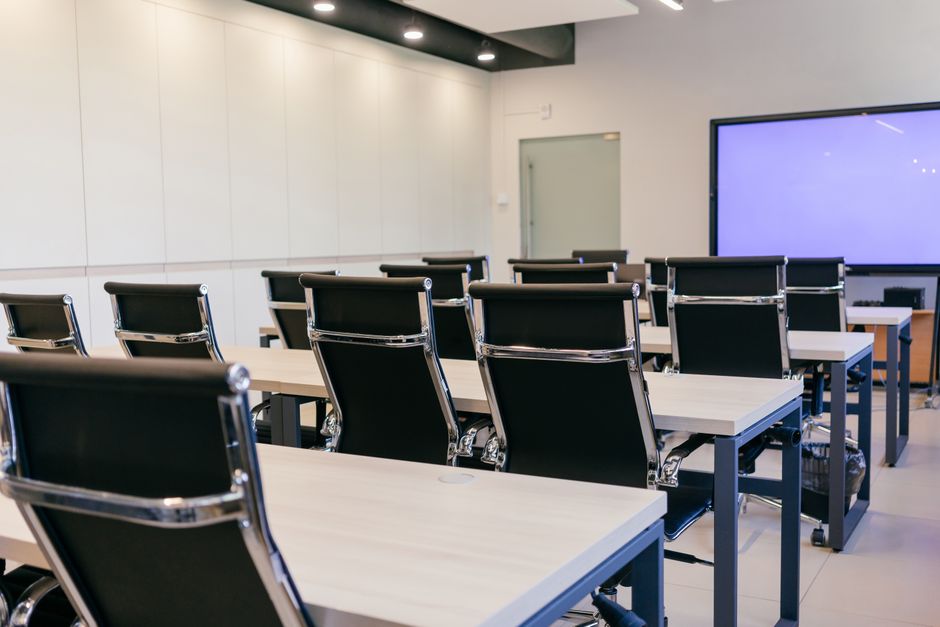
| Display / Presentation Screen | Large-format screen visible from all seats | Large presentation screen integrated into the Conference Room |
| Air Conditioning Reliability | Consistent, independent AC — not central building HVAC | Fully air-conditioned room with independent climate control |
| Backup Power | Generator auto-switchover under 30 seconds — NEPA outages are unpredictable | Reliable backup generator covering the entire venue |
| Seating Configuration Flexibility | Reconfigurable layout to suit camera angle requirements | Flexible seating layouts around a large conference table |
| In-Room Refreshments | Self-contained station — participants should not leave mid-session | Dedicated self-contained tea and coffee area within the room |
| Room Capacity | Defined fixed capacity — avoid overcrowded rooms that degrade audio | Exactly 20 persons — no overbooking beyond spec |
How Do You Set Up Video Conferencing Equipment in a Boardroom?
The physical arrangement of a conference room determines whether remote participants feel like full contributors or passive observers. Most hybrid sessions fail not because of bandwidth but because of poor camera positioning and unmanaged audio zones.
Camera placement is the first decision. A single wide-angle camera mounted at eye level at one end of the table — pointed toward the in-person group — gives remote participants the clearest view of who is speaking. Avoid mounting cameras above the screen, which creates an unnatural downward angle that makes the room look like a surveillance feed rather than a meeting.
Audio is the second, and more consequential, decision. Remote participants experience your meeting primarily through sound. A room with hard walls, no acoustic treatment, and a single omnidirectional microphone placed at one end of a long conference table will produce hollow, echoing audio for anyone dialing in. For a 20-person conference table, two boundary microphones or a conference microphone array placed at intervals along the table length is the correct approach.
Screen placement must serve both audiences. In-person participants should be able to see remote attendees’ video tiles on a display screen without turning away from the central presenter. Remote attendees should be able to see shared presentations clearly — which means the screen resolution and streaming quality must be tested before the session starts, not during it.
What Backup Power Systems Prevent Hybrid Meeting Disruptions in Lagos?
Any Lagos professional who has managed a critical meeting knows that NEPA reliability is not a planning assumption — it is a risk variable. Power outages in Lekki and across Lagos can strike at any hour, and a one-minute interruption during a board presentation or investor call is not recoverable in terms of professional credibility.
A hybrid meeting venue in Lagos must have three layers of power continuity to be considered genuinely reliable:
- Automatic generator switchover: The generator must activate within seconds of a grid interruption — not minutes. Any gap longer than 30 seconds will drop active VoIP and video calls that require a full reconnection cycle.
- Generator fuel reserve: Ask any Lagos venue how many hours their generator can run on a full tank. A half-day booking requires a minimum of six hours of guaranteed fuel capacity; a full-day booking requires ten or more. Request this in writing.
- UPS (Uninterruptible Power Supply) for networking equipment: Even a fast generator switchover creates a brief voltage gap. Routers, switches, and fiber termination equipment should sit behind a UPS unit so the internet connection never drops, even as the generator kicks in.
The Palmington addresses this directly. Its backup generator system covers the full venue, meaning the Conference Room’s fiber connection, air conditioning, and display infrastructure remain active through power interruptions without requiring meeting participants to pause and reconnect.
When evaluating venues, ask the venue coordinator to walk you through exactly what happens the moment NEPA goes out. If they hesitate, or if the answer involves any waiting period before the generator engages, that venue carries risk for a hybrid session.

What Pre-Meeting Technical Checks Should You Run for a Hybrid Session?
The most avoidable hybrid meeting failures in Lagos are caused by skipping technical verification before participants join. A 15-minute pre-check run by the host or a designated technical lead eliminates the majority of in-session disruptions. Run through this checklist before every hybrid session:
- Bandwidth speed test: Run a speed test (Speedtest.net or Fast.com) on the venue’s dedicated fiber connection. Confirm both upload and download speeds meet the session’s requirements. If the venue cannot confirm which connection your room is running on, escalate before proceeding.
- Video platform login and room test: Open the meeting link on the in-room device, join as a participant from a separate laptop or phone, and verify that both video and audio streams are clear in both directions.
- Camera positioning verification: View the in-room camera feed from the remote participant device. Confirm that every seat at the conference table is visible in-frame, and that the camera angle is at eye level — not pointed at the ceiling or the middle of the table.
- Microphone audio zone coverage: From the remote device, speak and listen. Walk to different ends of the conference table while someone monitors the audio quality remotely. Identify and resolve any dead zones where voice pickup drops.
- Screen-sharing and display test: Share a presentation or document from the host device. Confirm that in-room participants can see it on the presentation screen and that remote participants receive it without pixelation or lag.
- Backup power status confirmation: Verify with venue staff that the generator is fuelled and auto-switchover is active. Do this verbally and before the meeting starts — not as a question you ask mid-session.
- Remote participant dial-in confirmation: Send a test invite to one remote attendee and confirm they can join, see shared content, and be heard and seen by in-room participants at least 10 minutes before the formal start.
Why Does Venue Location in Lagos Affect Hybrid Meeting Logistics?
Location affects hybrid meetings in Lagos in ways that are specific to this city. Third Mainland Bridge traffic during peak hours — typically 7:00 AM to 10:00 AM and 4:30 PM to 8:00 PM — means that in-person participants coming from the mainland for a morning session need to factor in journey times that would be implausible in most other cities. A 9:00 AM start in Lekki, for a participant leaving from Yaba or Surulere, may require leaving before 7:00 AM to guarantee punctuality.
For hybrid meetings where some participants are coming in-person and others are joining remotely, this asymmetry matters. Remote participants join on time. In-person participants can be delayed by 45 minutes due to traffic, creating a session that starts fragmented. Experienced Lagos meeting planners account for this by scheduling in-person participant arrival windows and using the pre-meeting technical check period to run relationship-building conversation rather than waiting in silence.
The Ikate, Lekki location of The Palmington reduces this friction considerably for participants based on Lekki Peninsula, Victoria Island, and Ikoyi — the corridors where most Lagos corporate offices, professional service firms, and financial institutions are clustered. For participants coming from further across Lagos, WhatsApp coordination on traffic conditions in the hour before the meeting is a practical and widely used method among Lagos professionals.
Lagos venue selection for hybrid meetings should also factor in whether the venue is in a location with reliable generator fuel access and where telecom tower density is sufficient to support mobile data backup if the primary fiber connection ever requires a failover scenario.
How Should You Book a Hybrid-Ready Conference Room in Lagos for Maximum Value?
Booking a dedicated conference room in Lagos for a hybrid session is most effective when the booking window aligns with your session’s actual technical requirements — not just the formal meeting duration. Build in time for pre-meeting setup and the post-meeting debrief.
The Palmington Conference Room, with its 20-person capacity, is available under two booking structures:
- Full Day: 9:00 AM – 6:00 PM — covers extended hybrid sessions, multi-agenda board meetings, and training-to-meeting hybrid days
- Half Day (Morning): 9:00 AM – 12:00 PM — suited to executive briefings, investor calls, and focused hybrid workshops
- Half Day (Afternoon): 2:00 PM – 6:00 PM — allows in-person participants from across Lagos to avoid the worst of morning traffic before joining
When comparing hybrid meeting venues in Lagos, the afternoon half-day slot is underused and strategically intelligent. In-person participants can travel during off-peak hours, remote international participants in European time zones join in the afternoon as their own business day begins, and the session avoids the infrastructure pressure of early-morning peak demand on Lagos power and internet networks.
For high-stakes hybrid sessions — board meetings, investor presentations, quarterly reviews — always book a full day even if the meeting itself is four hours. The buffer on both ends gives your technical setup time and recovery time if any component requires adjustment before remote participants join.
If you are ready to confirm a hybrid-ready conference room in Lagos that eliminates the infrastructure risks this guide has outlined, contact The Palmington directly — the Conference Room’s dedicated independent fiber and reliable backup generator are already in place, so your only remaining task is to book the date.
Frequently Asked Questions
A hybrid-ready venue in Lagos must provide dedicated — not shared — fiber internet, a large presentation screen visible to all seats, reliable air conditioning, and an automatic generator that activates within seconds of a power outage. Without all four, at least one audience group will experience degraded participation during the session.
For a hybrid board meeting with six to twelve remote video participants, a minimum of 40 Mbps symmetrical dedicated bandwidth is required. For sessions with up to 20 remote participants, target 80 Mbps symmetrical. Shared building Wi-Fi or mobile hotspots are not adequate for any professional hybrid session and will produce dropped calls and degraded video.
Ask four questions before signing: Is the internet connection a dedicated fiber line or shared building bandwidth? What is the upload speed under load? How fast does the generator switch over when NEPA goes out? And can you run a technical test in the room before the booking date? A venue that cannot answer all four clearly carries infrastructure risk for a high-stakes hybrid session.
The Palmington, located at 6 VFC Close, off Meadow Hall Way, Ikate, Lekki, is a dedicated boutique conference venue with a 20-person Conference Room built for professional hybrid sessions. It operates on dedicated non-shared fiber internet, has a reliable backup generator, and is available for full-day or half-day bookings from 9:00 AM.